

Part of the Stories from the Greenbelt series
Highlighting the Importance of Nature Connectivity in Ontario with the Town of Pelham.
Pelham Greenbelt Natural Asset Management Project Highlights Importance of Nature Connectivity in Ontario.
A recent project in the Town of Pelham, Ontario, reveals how much communities in the Greater Golden Horseshoe region rely on nature, especially the intact ecosystems that make up Ontario’s Greenbelt, to provide essential community services such as clean water, temperature regulation and flood control.
In a first-of-its-kind study for the Town of Pelham, Council and residents understand the significant contribution – over $585 million – local forests and wetlands provide directly to the community in stormwater management and flood control services.
The Pelham Greenbelt Natural Asset Management Project outlines how much it would cost to replace these services with traditional, engineered infrastructure, and develops management and financial strategies to maintain these ecosystems and services for the long-term. This approach is similar to how local governments manage traditional infrastructure assets such as roads and bridges. In fact, Ontario’s regulation overseeing the management of municipal infrastructure requires the inclusion of nature-based services and related ‘natural assets’ in local plans.
Ontario’s leadership in requiring municipalities to recognize core services provided by nature is a sustainable, cost-effect and climate resilient approach to building communities. It also helps governments appreciate the tremendous value of the Greenbelt and we are excited about the work the Town of Pelham has done, the smallest community in the region to complete such as detailed study.
In a first-of-its-kind study for the Town of Pelham, Council and residents understand the significant contribution – over $585 million – local forests and wetlands provide directly to the community in stormwater management and flood control services.
Health of the Greenbelt has Wide-Reaching Impacts
The project area included significant natural lands that intersect with the Ontario Greenbelt, defined by the ecological boundary of the Upper Twelve Mile Creek subwatershed.
- Upper Twelve Mile Creek (UTCM) is a largely untouched ecosystem that boasts diverse flora and fauna, unique geological landscapes and a self-sustaining population of Brook Trout. Stewarding the health of the watershed is crucial for maintaining high-quality groundwater for Pelham, while mitigating erosion and controlling floods.
- Ontario’s Greenbelt covers 2 million acres of protected farmlands, forests, wetlands, and rivers; the Greenbelt provides an immense amount of ecosystem services to the wider region, and its health affects drinking water quality for more than 7 million Canadians.
Maintaining the health of natural features and ecosystem functions in the watershed and Greenbelt lands is necessary to retain the level of stormwater and flood control services currently provided to the Town. Pressures degrading natural areas include pollution, total impervious area, estimated at over 20% of the subwatershed, and climate change.
In servicing communities, it is always more worthwhile to protect what we have and avoid the need to build new and often more costly infrastructure. Services provided by nature also have the benefit of being more resilient and responsive to changes in weather and climate change. The Pelham Greenbelt project is a strong example of how unique natural assets are. They cannot simply be ‘replaced’ by a different natural area, as the original assets are already providing services (and co-benefits) which that locale relies on. While all natural spaces are vital in their own ways, some provide greater benefits to the surrounding communities.
Valuing Stormwater Services in Ontario
The project includes an evaluation of the stormwater management and flood control services provided by natural assets in the subwatershed, allowing Pelham to compare the estimated current and future costs of replacing local forest and wetland ecosystems with traditional, engineered solutions such as stormwater ponds or bioretention facilities.
The analysis showed that preserving the health of these ecosystems has a strong advantage: it would cost Pelham, a small community of 18,000, $585,859,327 to replace the stormwater and flood services provided by nature. The project further highlights:
- The significant value of wetlands to communities. In Pelham, stormwater management services provided by local wetlands are ten times more costly to replace than forests $197.49-$242.73 vs. $18.54-$28.72.
- The complete or ‘catastrophic’ removal of local forests and wetlands would increase peak flow rates during 100-year storm events by 486% in some areas (six times the current flow rate), likely resulting in significant flooding and damage that would be difficult to replicate with traditional infrastructure.
Communities downstream from Pelham in the Twelve Mile Creek Watershed, including the Towns of Thorold and Lincoln and the City of St. Catherines, also benefit from investments made by Pelham to maintain and enhance ecosystem services in the upper reaches of the watershed, but these may go unnoticed or recognized.
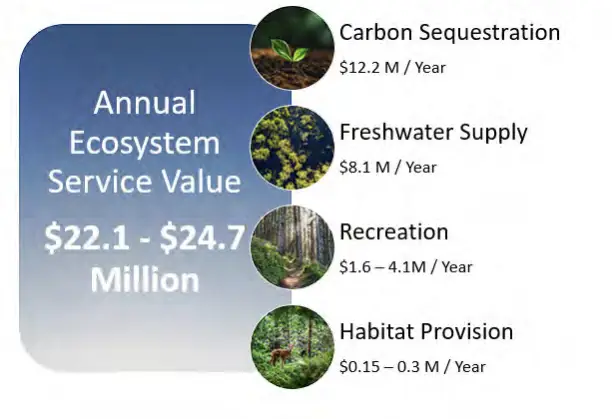
Stormwater management is only one of the many ecosystem services that the Upper Twelve Mile Creek subwatershed provides. Different approaches and previous studies were used to assess the value of additional community services, specifically recreation, carbon sequestration, freshwater supply, and habitat provision. Natural assets provide an estimated $22.1 – $24.7 million a year in value across these four services.
A Path for Pelham—and an Example for Early-Stage Local Governments
This project is one of a few studies of its kind completed by a small municipality in Ontario. The resulting report presents an example for other municipalities as they work towards the requirements of O.Reg 588/17 and integrating ‘natural assets’ into their overall asset management programs.
Its unique scope means that project results can also be used to invest in stewardship and restoration of natural systems and protect ecological connectivity and biodiversity across the municipality and the Greenbelt, which will only become more important as governments manage infrastructure, development needs and the growing impacts and costs from climate change.
Natural asset management is an ongoing process and the project includes recommendations to guide the Town of Pelham through next steps including financial planning to maintain ecosystem services.
Detailed recommendations are available in the Technical Report, and the key takeaways can be applied to any community interested in progressing resilient, cost-effective service delivery through ecosystem services:
- Protect What You Can
It’s easier to protect existing ecosystems than it is to rehabilitate them if degraded. Actions can include policy reviews/bylaws to ensure natural areas are proactively management where possible; naturalization of priority areas; and continued efforts to secure or protect forests and wetlands. - Make Evidence-Based Decisions to Manage Natural Assets
Monitoring, management, and assessment activities are continuous, and local governments can benefit from using existing studies and increasing their capacity for regular data collection where possible. For Pelham, priority actions include identifying risks to erosion sites and formalizing their invasive species management. - Build Awareness and Partnerships
Many of the natural assets that provide services to Pelham residents are not owned by the Town of Pelham, and it does not have direct control over their management. Collaborative partnerships with neighbouring jurisdictions (rightsholders and stakeholders), and building awareness of the benefits of natural assets among its Council, staff, and the public is necessary to generate support and implement effective natural asset management strategies.
Pelham Greenbelt Natural Asset Management Project
Keep up-to-date with natural asset management in the Town of Pelham at pelham.ca/living-in-pelham/natural-asset-management-plan/